Showing posts with label broncho billy. Show all posts

Sunday, December 1, 2013

Gilbert M. Anderson and the Rise of the Western Star

GM Broncho Billy Anderson
G.M. "Broncho Billy" Anderson

Thanks to my recent work with Essanay, I was given the exciting opportunity to pen a series of blog posts for the wonderful Classic Movie Hub site. The second post is live, and all about Broncho Billy himself. Here's an excerpt to get you started:

G.M. Anderson, best known by his onscreen persona of Broncho Billy, holds a special place in film history. Not only did he have multiple roles in one of the most iconic silent films of all time, “The Great Train Robbery,” he also co-founded Essanay Studios, discovered a number of iconic silent film stars and created a character archetype that spawned an entire genre of film. Anderson’s persona and image became so entwined with that of cowboy Broncho Billy, that audiences truly believed he’d been a rough rider all of his life. In actuality, he was a stage actor who’d grown up in St. Louis.

You can read the entire post over at the Classic Movie Hub by clicking here.

Saturday, July 27, 2013

Marguerite Clayton: The Broncho Girl of the Essanay Company

Marguerite Clayton

Marguerite Clayton never quite eclipsed her famous leading man G.M. “Broncho Billy” Anderson, but she managed keep a respectable film career alive for 15 years before retiring right around the introduction of sound. From humble beginnings, to becoming one of the most popular photoplayers in the early days of the industry, Clayton had quite a career and, fortunately for us, some of her work is still available for us to enjoy.

Marguerite Clayton

Margaret Fitzgerald was born in Ogden, Utah on April 12, 1891 (some sources say 1892) to Irish and Welsh parents. She was the third of four children born to Michael and Belle Fitzgerald, but little is known about her early years. She proudly told fan magazines that she had entered right into the motion picture industry without having done any real stage work (though later interviews dispute that). She was educated at convent called St. Mary’s in Salt Lake City and sang in the tabernacle from a young age. Her father was a mining engineer, and by 1910, the family seems to have made the move from Utah to San Francisco, where her father ran a bar.

Marguerite Clayton

Despite having no familial connection to the stage, Clayton found herself drawn to film, and began to dream of appearing on screen. When a LA-based paper ran an ad that said the western branch of Essanay was searching for actresses to join the company, she was quick to respond. In mid 1913, she joined the Essanay company doing small parts. The bit roles didn’t last long though, for after about 3 months she was starring alongside Mr. Anderson himself in his “Broncho Billy” pictures.

Marguerite Clayton and G.M. Anderson in a Broncho Billy film
Marguerite Clayton and G.M. Anderson in a Broncho Billy installment

She was inexperienced, but that seemed to play to her benefit. “I decided when I went into motion pictures that I didn’t know a thing about them, and that I would do just as the director told me. I have always followed that rule. No matter what the director says, I do it.” She was also focused on becoming a true film artiste. “I intend to keep on working until I am at the top. If I could always be sure of as good a teacher as Mr. Anderson is, I am sure I’d have no doubts of getting there.”

Marguerite Clayton and Richard Travers in "The Egg"

Clayton briefly left the company to pursue a part in a stage production called “The Candy Shop,” and later briefly left the company to pursue parts with the Liberty company. But by April of 1915, she was back at Essanay and back with Broncho Billy. Although she had grown into a western star courtesy of the Niles branch of Essanay, by late 1915, she found herself established at her new home at the Chicago branch. Rather than playing opposite the rugged G.M. Anderson, she found herself playing leads with handsome Richard Travers, and rather than playing in westerns, she found herself in dramas and light comedies. Her first role at the Chicago branch was “A Daughter of the City,” a morality play in which she played the titular role and got to show her range.
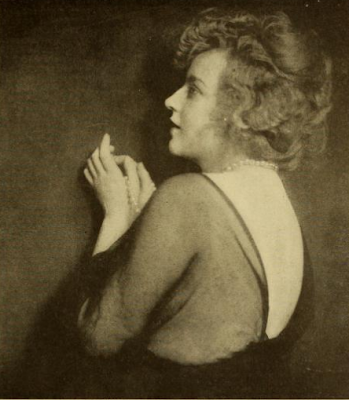
Marguerite Clayton

She was one of 12 players added to the Essanay stock company and, in 1917, one of the players who got to play in Essanay’s line of Black Cat Features -- snappy, sharp, two-reel comedy dramas that were based on Black Cat Magazine. She even starred in a unique picture where she, through some trick photography, was turned into a living doll. Despite being one of the company’s favorite and most consistent players, in late 1917, Clayton left the company to freelance with Paralta and later Artcraft, Paramount, and Paragon. In mid-1918, she made her last major picture splash with “Hit-the-Trail Holliday,” a prohibition play written by and starring George M. Cohan. She was happy with the change of scenery her parts had taken, telling fan reporters, “I wouldn’t go back into Western stuff for the world,” but her career was starting to slip.

In 1922, she sued Pathe for $50,000 in damages when she was struck by a pipe while filming. She alleged that the injury had left her with a permanent facial scar, but it’s unclear whether the case ended in a ruling or a settlement. She continued to work in film in both the US and Europe, but by the time the talkies started to take hold in the late ‘20s, she had disappeared from the screen.

Marguerite Clayton

With the ‘30s came her marriage to Victor Bertrandias, a major in the US Air Force, and her retirement from the screen. She took Victor’s last name, and, save for a few instances, managed to stay out of the spotlight. The couple were married until his death in 1961. Marguerite died seven years later.

Marguerite Clayton

The name of Marguerite Clayton never rose to the ranks of a Norma Talmadge or a Mary Pickford, but thanks to her work in the "Broncho Billy" series, she’s achieved an immortality among silent film lovers. To watch the Broncho Girl of the Essanay Company in action, check out two installments of the “Broncho Billy” series below.


Monday, January 16, 2012

Edwin S. Porter and “The Great Train Robbery”

The Great Train Robbery

In the words of Adolph Zukor, Edwin S. Porter was more of an artistic mechanic than a dramatic artist. This glimpse into the personality and mind of Porter tells us much about the man behind one of the most famous silent films of all time -- “The Great Train Robbery.”


Edwin S Porter
Edwin S. Porter
Porter was an innovative director, but his work and achievements have since been overshadowed by the work of those who followed, namely D.W. Griffith. Porter began creating films by recreating news events and even shooting people on the street. By creating narratives and editing the footage himself, Porter took editorial control away from the exhibitors, something that other directors would soon take for granted.

Porter also liked to end his films with, pardon the pun, a bang. In the documentary, “Before the Nickelodeon: The Cinema of Edwin S. Porter,” silent film star Blanche Sweet describes how Porter would borrow “the use of a final punchline from comic strips.” Probably the best-known example of this in Porter’s work is the final scene in “The Great Train Robbery” with the dramatic switch from a long shot to a closeup of cowboy who fires his gun at the viewer. Not only does it serve as a final jolt to the audience, it also breaks the fourth wall and anticipates the use of the closeup for dramatic effect.


The Great Train Robbery


The Great Train Robbery

It’s difficult to overstate the importance of “The Great Train Robbery” because it was so revolutionary in so many ways. Released in 1903, it helped establish the western as a film genre and it demonstrated how a film could be edited to convey events that are occurring simultaneously. It’s easy to forget how innovative “The Great Train Robbery” was, especially since it uses many techniques that we take for granted today. Surprisingly, Porter failed to realize what was so special about his work. As the documentary and other works on silent film detail, although Porter invented revolutionary techniques, he failed to implement them in subsequent films and failed to break through the constraints of the medium (hence Zukor's quote). In just a few years, Porter’s contributions to film were dwarfed by contributions made by some of the actors that were featured in his films (“Broncho Billy” Anderson, D.W. Griffith), often reducing his name to little more than a footnote in the history of silent film.


The Great Train Robbery
"Broncho Billy" Anderson as a tenderfoot dancer
At less than 10 minutes long, “The Great Train Robbery” serves as an excellent introduction to silent film for those who are unfamiliar with them. Though primitive compared to the work of silent film giants like Cecil B. DeMille or D.W. Griffith, the film is interesting and easy to understand, even without the use of intertitles.


You can watch “The Great Train Robbery” in its entirety below. 

The Great Train Robbery, the American Silent Western by Edwin S. Porter

Flash 10.2 or above Required

To view films, please download Flash.
If you have an iPad or iPhone Download Fandor from the App Store.


Eager to learn more about Edwin S. Porter? Check out the “Before the Nickelodeon” documentary below.

before_the_nickelodeon

Flash 10.2 or above Required

To view films, please download Flash. iPhone, iPads and some other platforms do not support Flash. If you would like to be notified when Fandor comes to these devices, send an email to info@fandor.com.