Showing posts with label d.w. griffith. Show all posts

Wednesday, May 15, 2013

The Actor Who Wore a Mustache: Joseph Graybill

Joseph Graybill

Joseph Graybill was born on April 17, 1887 in Kansas City, Missouri. The family was primarily based in Kansas and Wisconsin, with Graybill seeking education at the St. John’s Military Academy in Salina and the Milwaukee Academy. At the age of 18, Graybill made his theatrical debut, joining the Thanhouser Stock Company in Milwaukee. From there, he traveled with a variety of theatrical companies, working with Henry Woodruff in a production of “Brown of Harvard” and doing juvenile leads and comedic parts in productions by Henrietta Crosman and Henry E. Dixey. It was his performance in “The Witching Hour” in 1908 that really began to attract the attention of writers and critics.

In an interview with the Chicago Daily Tribune from the same year, Graybill spoke at length about his process from bringing the the murderous character of Clay Whipple to life. The reporter wrote, “he works himself up to a pitch of excitement so that he breathes hard in the wings before he goes on...the young actor has to practically hypnotize himself to keep neutral until the instant of the tragedy.” Even at the age of 21, Graybill clearly had a gift for losing himself in his roles. Following this successful run, Graybill did a tour in a supporting role in “Awake at the Switch” on vaudeville before joining the industry which would bring him the most recognition.

In 1910, Graybill joined Biograph. His timing was such that he got to work on-screen with some of the earliest actors, actresses and directors to grace the big screen. He worked with the likes of Mary Pickford, Blanche Sweet, Mack Sennett and Henry B. Walthall, and worked under a relatively new director by the name of D.W. Griffith. Because he was still new to the film world, there was a bit of competition between Graybill and the veteran actors. Linda Arvidson (Griffith’s wife at the time) wrote in her memoir that Griffith was very pleased with Graybill very early on. In an effort to mess him up, fellow actors Charlie West and Arthur Johnson tried to get him drunk on set in the hopes that he would flub his performance, but to their dismay, he held his own and only impressed Griffith more. It was in these Biograph performances that Graybill began to establish a following.

Mary Pickford, Mack Sennett, Joe Graybill and Marion Sunshine in "The Italian Barber"

One of his most interesting early roles is that of “The Stranger’ in Griffith’s “The Painted Lady” from October 1912. Starring a young Blanche Sweet, Graybill plays a burglar who users Sweet’s attraction to him as a means to rob her father. His plan backfires, however, when Sweet decides to take matters into her own hands.

Graybill worked for Biograph in New York and California before making the rounds to other big-name companies of the day. He worked for Lubin, IMP, Keystone and the Victor Company before joining the World’s Best Film Company. Upon joining World’s Best, it was announced in January 1913 that Graybill had been tapped to play the lead in a new “animal picture.” it was to be filmed in Jacksonville, Florida, under the title “The Wizard of the Jungle,” and it would later become Graybill’s best known film. His turn as the jealous Captain Hanscomb earned him a glowing review from Moving Picture World. They said he was at his best playing jealous lovers and that his role in “Wizard” was no exception. He joined Pathe around the release of “Wizard” and seemed to be moving on to even better and bigger opportunities. Unfortunately, tragedy struck.

Joseph Graybill in The Painted Lady
Joseph Graybill in "The Painted Lady"

While filming with Pathe in Jersey City, Graybill suddenly collapsed. The Morning Telegraph reported that Graybill had been in a highly nervous state for several weeks “due to his tendency to worry.” (Considering the heightened state of excitement that Graybill would get himself into for his stage performances, this doesn’t seem that unlikely.) After dealing with this condition for several weeks, Graybill suffered a nervous breakdown on set. He collapsed and instantly lost the ability to see. Sources report that Graybill was so determined to finish filming, that he insisted that he be directed through the scenes using the director’s voice and commands. When filming ceased, he collapsed again and was hospitalized, later to be diagnosed with spinal meningitis. After spending a few days fighting for his life, Graybill died on August 3, 1913 at the age of 26. His mother and sister oversaw the service, with Pathe players in attendance and actors from a variety of companies acting as his pallbearers.

The issue of Moving Picture World that was released the day before his death was particularly poignant, as it spoke highly of Graybill’s strong body of work, and how they expected “the actor who wore a mustache” to continue with great performances into the future.

Unfortunately, Graybill was the first of the many bright young stars who would see their lives and careers end far too soon -- a list of stars which would include the likes of Wallace Reid, Rudolph Valentino and even Graybill’s former co-star Mabel Normand.

Blanche Sweet and Joseph Graybill
Blanche Sweet with Joseph Graybill in "The Painted Lady"

What would Graybill have gone on to achieve? His range was respectable, and though he had parted ways with Biograph, I can easily see him rejoining with Griffith’s independent company, playing roles that fellow Griffith player Bobby Harron (who also died tragically at a young age) excelled in. His filmography isn’t as extensive as other Griffith players, but we’re lucky to have surviving prints of many of his Biograph films. Click here for a playlist featuring some of the films of Joseph Graybill. Or check out "The Painted Lady" courtesy of Fandor below.

Flash 10.2 or above Required

To view films, please download Flash.
If you have an iPad or iPhone Download Fandor from the App Store.

Saturday, April 27, 2013

The Transformation of Olga Grey

Olga Grey

A music student turned actress turned lawyer? As odd as it may sound, that's the journey of Anushka Zacsek, better known to silent film fans as Olga Grey.

Olga Grey

Although her parents were Hungarian, Grey grew up and was educated in New York. Her father pushed her to pursue a career in music, specifically encouraging her to become a violinist. She had done some stage acting, but (as she told the fan magazines at the time) she impulsively decided that she wanted to pursue a career in film when she took a trip to the West Coast in 1915.

She signed with Triangle and found herself as an extra in several of D.W. Griffith's films. She had an uncredited role in "The Birth of a Nation," and also played the part of Mary Magdalene in the Christ narrative of "Intolerance." Though she never achieved the same kind of prominence that other Griffith ingenues would achieve (e.g. Mary Pickford, Lillian Gish, Mae Marsh), she found "important roles" in Douglas Fairbanks vehicles ("Double Trouble") and Mae Marsh vehicles ("The Wild Girl of the Sierras") which won her praise from critics.

Olga Grey in "Fanatics"
Still from "Fanatics"

Grey, like Theda Bara, used her exotic looks to her advantage, often playing exotic, vamp-like characters. Occasionally she found roles that allowed her to show more range, like the role of Lola Monroe in "Fanatics." Although she worked steadily, finding work with multiple production companies, by 1920 she had retired from the screen.

According to an interview with the Associated Press in 1935, when Grey left Hollywood she returned to the stage. She toured Europe, taking on the roles she never got to pursue on screen, including Anna Karenina and Judith of Bethulia. She began to dabble in films again when she returned to the US, and launched a theater in Los Angeles. One night, she confided in a lawyer friend that she was tired of acting. He urged her to study law and she she took his advice. She was admitted to the bar in 1932.

Olga Grey

When she was interviewed by Photoplay Magazine in 1917, Grey said that she had changed her name from Anna Zacsek to Olga Grey while she was in New York simply because it made life a little easier. Although the name change probably wasn't necessary (think of the actresses who came after her whose names were just as exotic as their personas), it gave her the opportunity to assume a new (or, rather, old) persona when she retired from the screen. No longer was she Olga Grey the silent film siren -- she was now Anna Zacsek the attorney.

In fact, for a period, she had the distinction of being one of only two practicing women attorneys located in Los Angeles. Not only that, she was also the defense attorney for three of the gang members charged in the Sleepy Lagoon Murder trial of 1942 (the trial cited as one of the sparks that led to the Zoot Suit Riots of 1943). Among her clients were Henry Leyvan, Victor Segobia and Edward Grandpre, and by all accounts, she was a strong and articulate presence in the courtroom.

Olga Grey

Although Grey found herself, to a certain degree, back in the spotlight, she never regretted leaving the stage or film behind her. She told the AP, "Now I'm supremely happy. Look at the excitement this gives me. The drama of it. And no make-believe. Do you think any of those roles I played ever gave me what this is giving me -- to know that nothing but myself stands between the happiness and mystery of a human being?"

Monday, January 16, 2012

Edwin S. Porter and “The Great Train Robbery”

The Great Train Robbery

In the words of Adolph Zukor, Edwin S. Porter was more of an artistic mechanic than a dramatic artist. This glimpse into the personality and mind of Porter tells us much about the man behind one of the most famous silent films of all time -- “The Great Train Robbery.”


Edwin S Porter
Edwin S. Porter
Porter was an innovative director, but his work and achievements have since been overshadowed by the work of those who followed, namely D.W. Griffith. Porter began creating films by recreating news events and even shooting people on the street. By creating narratives and editing the footage himself, Porter took editorial control away from the exhibitors, something that other directors would soon take for granted.

Porter also liked to end his films with, pardon the pun, a bang. In the documentary, “Before the Nickelodeon: The Cinema of Edwin S. Porter,” silent film star Blanche Sweet describes how Porter would borrow “the use of a final punchline from comic strips.” Probably the best-known example of this in Porter’s work is the final scene in “The Great Train Robbery” with the dramatic switch from a long shot to a closeup of cowboy who fires his gun at the viewer. Not only does it serve as a final jolt to the audience, it also breaks the fourth wall and anticipates the use of the closeup for dramatic effect.


The Great Train Robbery


The Great Train Robbery

It’s difficult to overstate the importance of “The Great Train Robbery” because it was so revolutionary in so many ways. Released in 1903, it helped establish the western as a film genre and it demonstrated how a film could be edited to convey events that are occurring simultaneously. It’s easy to forget how innovative “The Great Train Robbery” was, especially since it uses many techniques that we take for granted today. Surprisingly, Porter failed to realize what was so special about his work. As the documentary and other works on silent film detail, although Porter invented revolutionary techniques, he failed to implement them in subsequent films and failed to break through the constraints of the medium (hence Zukor's quote). In just a few years, Porter’s contributions to film were dwarfed by contributions made by some of the actors that were featured in his films (“Broncho Billy” Anderson, D.W. Griffith), often reducing his name to little more than a footnote in the history of silent film.


The Great Train Robbery
"Broncho Billy" Anderson as a tenderfoot dancer
At less than 10 minutes long, “The Great Train Robbery” serves as an excellent introduction to silent film for those who are unfamiliar with them. Though primitive compared to the work of silent film giants like Cecil B. DeMille or D.W. Griffith, the film is interesting and easy to understand, even without the use of intertitles.


You can watch “The Great Train Robbery” in its entirety below. 

The Great Train Robbery, the American Silent Western by Edwin S. Porter

Flash 10.2 or above Required

To view films, please download Flash.
If you have an iPad or iPhone Download Fandor from the App Store.


Eager to learn more about Edwin S. Porter? Check out the “Before the Nickelodeon” documentary below.

before_the_nickelodeon

Flash 10.2 or above Required

To view films, please download Flash. iPhone, iPads and some other platforms do not support Flash. If you would like to be notified when Fandor comes to these devices, send an email to info@fandor.com.

Tuesday, December 27, 2011

The New York Hat

The New York Hat (1912)


We return, as we will often do in this blog, to D.W. Griffith. Rather than examine another epic work of cinema, like "The Birth of a Nation," we, instead, turn to Griffith's days at Biograph. "The New York Hat" was made and released in 1912, four years into Griffith's incredibly prolific career. The film is simple and straightforward and charming. Although it is nowhere near Griffith's best work, it is notable for a number of reasons.

A Bit of Background

Griffith made his directorial debut in 1908 with a little film called "The Adventures of Dollie." Incredibly, this film has survived to this day (you can watch it here). Griffith had not dreamed of becoming a director. He had tried his hand as a playwright (out of his love for writing) and an actor (out of the need to make ends meet), but when one Biograph director became indisposed, and Biograph found itself in need of another director, Griffith took advantage of the opportunity. The result was at least on par with many of the films that had been produced by Biograph up until that time. Impressed and pleased with his own work, Griffith quickly became one of the most prolific directors at Biograph and, truly, its most visionary.

From 1908 to 1913, Griffith directed more than 400 films and established a close relationship with cinematographer Billy Bitzer, with whom he introduced enormous advancements in the art of film. It was also during these years that Griffith discovered and worked with some of film's biggest future stars. A number of them are even present in this film.

Mary Pickford
Mary Pickford
'The girl with the curls,' Mary Pickford, one of the screen's first and biggest stars, was one of Griffith's earliest and greatest discoveries. "The New York Hat" marks her final Biograph picture, but Pickford's friendship and partnership with Griffith would endure, leading to the formation, with Douglas Fairbanks and Charlie Chaplin, of the production company United Artists. 

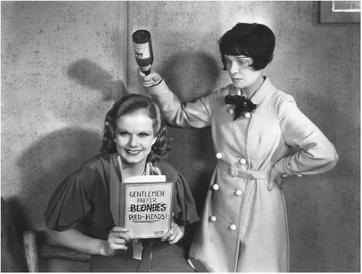
Also appearing in "The New York Hat" is Lionel Barrymore, who had joined Biograph in 1911. Although they do not appear in named or prominent roles in this film, we are also given a glimpse at some future Biograph stars, namely Lillian Gish and Mae Marsh. Another individual worth mentioning is the film's screenwriter, a then relatively unknown Anita Loos. If you don't know Loos by name, you certainly know her by her work. Among other screenplays and works of fiction, Loos penned "Gentlemen Prefer Blondes,"  "Red-Headed Woman" and "Gentlemen Marry Brunettes." Loos' talents would also be utilized by Griffith in 1916 to pen the titles for his epic follow-up to "The Birth of the Nation," "Intolerance." "The New York Hat" was one of Loos' first screenplays and doesn't bear much resemblance to her later works, but it certainly brought Loos her first big break and set the ball rolling for her as a screenwriter.

Jean Harlow with Anita Loos
The Story

Mary Harding, on her deathbed, leaves her pastor (Lionel Barrymore) with one request, that he use the trust she leaves to him to treat her daughter Mollie (Mary Pickford) to the "bits of finery" which her husband had constantly denied her and Mollie. Her only request is that he tell no one. The pastor takes this request to heart.

Scene from The New York Hat
The Pastor (Lionel Barrymore) reads Mary Harding's final request
Some time after, Mollie prepares to go out into the town, but upon examining her appearance, she hesitates. Her jacket is shapeless, the sleeves are too short and her hat is rather plain and old. She appeals to her father, asking if she can have a new hat. He, predictably, denies her request, leaving her to make do with her appearance and wardrobe.

Scene from The New York Hat
"Daddy, can't I have a new hat?"
Scene from The New York Hat


Scene from The New York Hat
Mollie (Mary Pickford) goes downtown, leaving her shabby hat behind
Whatever confidence she has instilled in herself prior to leaving her house is diminished when young women giggle and draw attention to her shabby, simple appearance. Like the other women of the town, Mollie soon finds herself down at the hat shop admiring the latest import from New York. Mollie encounters the pastor here, and he observes her lamentation that she cannot have or afford such a beautiful hat.

Scene from The New York Hat
Mollie admires the new hat in from New York
Scene from The New York Hat
Mollie laments the fact that she can't have the hat
Mollie leaves the shop brokenhearted. Remembering his promise to Mary, the pastor enters the store and purchases the hat, causing the town gossips to speculate. Hatbox in hand, the pastor finds Mollie at her home and leaves her with her present. In a beautiful little sequence, Mollie experiences a series of emotions, from astonishment, to joy, to sorrow.

Scene from The New York Hat
The town gossips speculate
Scene from The New York Hat
Mollie's range of emotions...from joy
Scene from The New York Hat
...to sorrow and feeling overwhelmed...
Scene from The New York Hat
...to pride
Taking pride in her appearance, Mollie wears her New York hat to church, causing a fuss among the gossips and church board members. Believing that Mollie and the pastor are having an affair, Mollie's father destroys her beloved hat, causing Mollie to seek refuge and sympathy from the pastor. In the climax, the pastor and Mollie are confronted by the town gossips, the church board and Mollie's father. The pastor assures everyone that his intentions were pure, showing everyone involved Mary Harding's final request to him.

Scene from The New York Hat
At church, Mollie is disregarded
Scene from The New York Hat
The gossips and church board members confront the pastor
Satisfied and, perhaps, annoyed by the pastor's explanation, the gossips and board members take their leave, leaving behind the pastor, Mollie and her father. The pastor has one final request, however, to have Mollie as his wife. Mollie shyly and giddily accepts his offer as the end intertitle card appears.

Scene from The New York Hat
Mollie accepts the pastor's proposal of marriage
The Result

A Broadway veteran at this point, it is interesting to see Lionel Barrymore at this stage in his career. Just 34, Barrymore was a newcomer to film and attempts to be bridging the very different worlds of stage and screen  acting. Pickford, however, was a film veteran at the age of 20 and her expertise in the realm of screen acting particularly shines in this film. Pickford's beautifully emotive face adds so much to the film, even if the story itself is quite simple.

It is because of the talent of Griffith, Pickford and other Biograph players that the Biograph company became the top studio at the time. As Lillian Gish recalled in the documentary "Hollywood: A Celebration of the American Silent Film," everyone copied Biograph. The desire to be as popular as Biograph made piracy a legitimate threat. In order to preemptively prevent such theft, Biograph, like other studios, made a point to conceal its logo within the scenery.

To glance at the following frame, one might think that the blocking and framing is rather curious. Such extra space would suggest that someone else would be joining Pickford in the scene.

Scene from The New York Hat

But upon closer examination, we see Griffith and Bitzer's reason -- by placing Pickford at the right side of the screen, the Biograph logo (AB for American Biograph) is cleverly placed in the background at the left side of the screen.


By placing studio logos in the scenes and intertitles themselves, competitors were unable to steal them and use them as their own.

Is "The New York Hat" as action-packed or dramatic as his other works of the period? No. But it is worth the watch for its sincerity, its sweetness and its featured players.

You can watch "The New York Hat," featuring the young and handsome Lionel Barrymore and the beautiful Mary Pickford, in its entirety below.

Monday, September 19, 2011

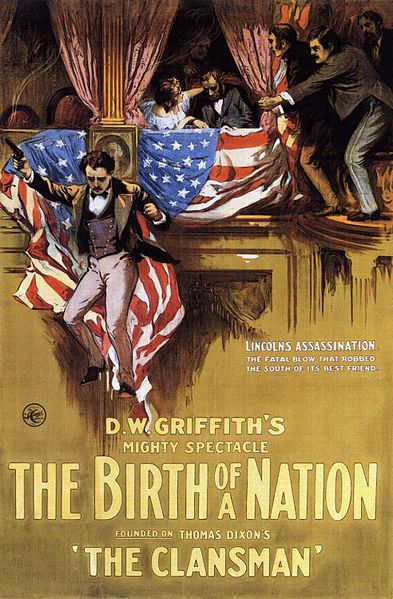
The Birth of a Nation

The Birth of a Nation (1915)
There is no question about the influence director D.W. Griffith has had on the art of filmmaking. He invented techniques that we take for granted today. And what he did not invent himself, he certainly perfected. Unfortunately, his genius was tarnished by the racist tones of “The Birth of a Nation.” I won’t address the issue of racism in “Birth of a Nation,” simply because individuals who are far more intelligent and articulate than I have already addressed it and they have addressed it better than I could. Instead, my task with this blog is to look past the blackface and examine the film for the incredible feats it does achieve, in terms of cinematography, acting, and design.


It is difficult now to experience “The Birth of a Nation” as audiences experienced it when it premiered in 1915. Prior to its release, most American films (including Griffith’s) were about 20-40 minutes long. “Birth” shattered that standard by clocking in at just over three hours. It was the first American epic film and the epic scope, scale, and feel of the film survive to this day. The story of the Stonemans of the North and the Camerons of the South has not lost its effectiveness or its emotion.
The Birth of a Nation disclaimer
The intertitle which appears at the beginning of the film
D.W. Griffith & Bill Bitzer
If Griffith is the father of modern filmmaking, then Bitzer is certainly the father of modern cinematography. Bitzer had been paired with Griffith since Griffith’s directorial debut and eventually became Griffith’s regular cinematographer. Together, the two captured the Civil War in a way that, until that point, only Mathew Brady’s photographs had done. The blood of the battlefield, the affect of war on home life, the difficulty of returning to normal life after war -- all were captured with an amazing degree of accuracy and realism that hit the audience in a way it had not anticipated.
Scene from The Birth of a Nation
This early equivalent of a crane shot illustrates the scale of the battle scenes
The battle scenes are thrilling and haunting. Thanks to Griffith’s direction and Bitzer’s photography (as it was referred to at the time), the audience finds themselves in the middle of the battles, not merely spectators. Indeed, we ride into battle with the regiment, an effect which seems commonplace now, but which all directors ultimately owe to Griffith and Bitzer. What’s more, the effect is just as thrilling now as it was during its premiere in 1915. The same technique is used later in the film as the Ku Klux Klan rides to the rescue of the Camerons and the technique is no less effective or powerful.
Scene from The Birth of a Nation
A powerful shot from the battle sequence
Scene from The Birth of a Nation
The KKK ride to the rescue of the Camerons
Just as Bitzer and Griffith prove that they are capable of capturing large-scale action, they prove that they are more than capable of capturing the more subtle interactions between actors. When the Stoneman boys and the Cameron boys enlist to find for their respective sides, the families who were once close have suddenly become mortal enemies. This becomes painfully clear as a Stoneman and Cameron perish just inches from each other on the battlefield.
Scene from The Birth of a Nation
Stoneman and Cameron die side by side
Perhaps the most moving scene of the film is the homecoming scene, in which the “Little Colonel” returns home after serving for years in the war. Henry B. Walthall plays the Little Colonel, Ben Cameron, with heartbreaking realism, while the effervescent Mae Marsh plays his little sister who loves him dearly. The two are closer than any of the other family members and the excitement of seeing one another after so many years is more than either can stand.


But as the Little Colonel returns home, he is confronted with the life he left behind and the life he must lead now that the war is over. The scene is beautiful and haunting at the same time as the siblings’ joy is so quickly replaced with discomfort and uncertainty. You can watch the scene below.
Of course, Griffith and Bitzer could not have achieved such a powerful film without an incredible cast.


The Players
A commonly emphasized theme in Griffith’s films is innocence and none is more innocent, especially in “Birth,” than Mae Marsh. As the lovable Flora Cameron, Marsh beautifully embodies childhood innocence as it is forcefully faced with the dangers and evils of the world. Her energy bubbles over into every facet of her performance. Even when the Cameron household is raided and Flora, her sister and her mother seek refuge in the cellar, Marsh reminds us of how much of a child Flora really is with her nervous excitement and giggles.


She’s fearless and optimistic, a stark contrast to her sister who often seems simply catatonic. And when her brother returns from the war, she is the first to to run out and greet him. Marsh’s performance is beautiful, as she runs around trying to make herself presentable to her hero -- her big brother.


Scene from The Birth of a Nation
Flora (Mae Marsh) puts on her finest for the return of her brother


Scene from The Birth of a Nation
A sweet moment from the homecoming scene between brother and sister
The homecoming scene’s brilliance is due, in part, to Griffith and Bitzer, but it is largely due to Marsh’s performance and the performance of the Little Colonel himself, Henry B. Walthall. Ben is first the optimistic, eager young man who is ready to fight for the Confederacy, perhaps without fully understanding what would be expected of him. After a few years on the frontline, however, his spark begins to die down. By the time he returns home, he is a jaded man, having experienced death and loss firsthand. The eyes which once sparkled with life and joy become haunted upon returning home, and the pain he feels eventually turns to rage.
Scene from The Birth of a Nation
Ben (Henry B. Walthall) and his haunted stare
Scene from The Birth of a Nation
Ben's pain turns to rage as Flora dies in his arms
The intensity that Walthall exhibits in the battle sequences and the KKK ride sequences is incredible. All of his energy is invested in those scenes and that ferocity is paired with the heart-pounding cinematography of Billy Bitzer, causing even the modern audience to slide to the edge of their seats as their hearts race.
Scene from The Birth of a Nation
Ben charges
For Ben Cameron, few can ignite the love for life that once dwelled within him, among them are, of course, little Flora and his love, Elsie Stoneman, played by the wonderful Lillian Gish.


Gish’s career spanned more than 70 years, a feat which is nearly unfathomable. Not only was she present when the movies moved from nickelodeons to respectable theaters, she was also present for the introduction of sound, color, television and VHS tapes and VCRs. Of course, it’s not Gish’s longevity that we remember her for. Above all else, we remember her beauty and her dedication to her craft -- both of which are demonstrated in “Birth of a Nation.”


Joe Franklin described Ms. Gish as ethereal, and I think that is the perfect word to describe her. Her beauty and talent are almost not of this world and this is used to great effect in “Birth.” As Elsie, daughter of Congressman Stoneman, she has an angelic quality. Ben idolizes Elsie before he even meets her, and when he regains consciousness in the hospital Elsie is his own personal Florence Nightingale, heightening her angelic qualities.
Scene from The Birth of a Nation
The angelic Elsie Stoneman (Lillian Gish)
Griffith and Gish were not content to simply leave Elsie as this out-of-reach creature, however, and Gish shows her range during the second half of the film. She swiftly falls from the highs of love with Ben, to the depths of despair when she realizes that he is a member of the Klan. And the terror and hysteria she displays when she is trapped within Silas Lynch’s home brings this ethereal being down to Earth in a frightening way.
Scene from The Birth of a Nation
Elsie realizes she is trapped in the Lynch house
Conclusion
It’s difficult to watch “The Birth of a Nation” objectively, but if a viewer can do it, it can be an incredible movie-viewing experience. The genius present in the film cannot be denied, even if its faults tend to overshadow it.